Views: 0 Author: Site Editor Publish Time: 2025-12-11 Origin: Site
In the logistics and material handling industry, a common interview question for safety managers is: "What is the most important safety device on a forklift?"
If you strictly follow OSHA guidelines and engineering standards, the technical answer is the seatbelt. In the event of a tip-over—the most common cause of forklift-related fatalities—the seatbelt is the primary device that keeps the operator inside the protective cage and saves their life.
However, in the modern warehouse environment, relying solely on a "reactive" device like a seatbelt is no longer enough. A seatbelt mitigates damage after an accident occurs. But what if the most important device was one that prevented the accident entirely?
At Toptree, we are redefining warehouse safety by moving from passive protection to Active Accident Prevention. Here is a breakdown of why the definition of the "most important safety device" is evolving, and the technologies you need to stay compliant and safe.
Since the seatbelt is legally the most critical device, the biggest risk factor is human error: operators forgetting or refusing to wear it.
A standard seatbelt is useless if it isn't buckled. This is why many fleet managers are upgrading to a Forklift Safety Belt Safety Warning System.
● How it works: An audible alarm will sound continuously until the seatbelt is securely fastened.
● The Benefit: It transforms a passive safety strap into an enforced safety protocol, ensuring 100% compliance without requiring constant manager supervision.

Forklifts are plagued by blind spots. The mast, the load, and the cage pillars all obstruct the driver's view. In a noisy warehouse, a simple horn is often drowned out by ambient noise.
Therefore, for pedestrian safety, the most important devices are Visual Warning Solutions.
Visual communication is faster than auditory warnings.
These project a bright blue beam on the floor several meters ahead of or behind the forklift. When a pedestrian sees the blue light moving across an intersection, they know a vehicle is coming, even if they can't see the forklift yet.

These project a bright red line along the sides of the forklift, creating a visual "No-Go Zone" (or Halo Zone). This shows pedestrians exactly how much distance they must keep to avoid foot injuries from rear swing.

When a worker at a blind intersection sees an arrow on the floor, they instantly know not just that a forklift is approaching, but exactly which way it is traveling, allowing them to react faster and safer.

This is the game-changer for rear safety. Unlike straight lines, the Arc Light projects a continuous U-shaped curve around the back of the forklift. This accurately highlights the rear swing radius, ensuring pedestrians stay clear of the most unpredictable part of the vehicle during a turn.

Standard floor tape wears off and gets dirty. A Forklift Logo Projector casts bright, indestructible warning signs (like "STOP" or "WARNING") directly onto the floor. It is dynamic, impossible to ignore, and vital for high-traffic intersections.


If we look at the future of logistics, the title for "Most Important Safety Device" belongs to the Forklift AI Camera System (Collision Avoidance System).
Mirrors and backup cameras rely on the driver constantly checking them. AI systems, however, are always watching.
● Pedestrian Detection: Using advanced algorithms, these cameras can distinguish between a static object (like a pallet) and a human being.
● Active Intervention: If a person enters the hazardous zone, the system creates an immediate alert for the driver.
● The Toptree Advantage: Our advanced systems can even integrate with the forklift's controls to automatically slow down or stop the vehicle when a collision risk is detected. This is the ultimate level of protection.
Accidents often happen when operators are rushed. Speeding and lifting uneven loads are recipes for disaster.
You cannot always trust operators to self-regulate. A speed limiter ensures that the forklift never exceeds safe warehouse speed limits, regardless of how heavy the driver's foot is on the pedal.

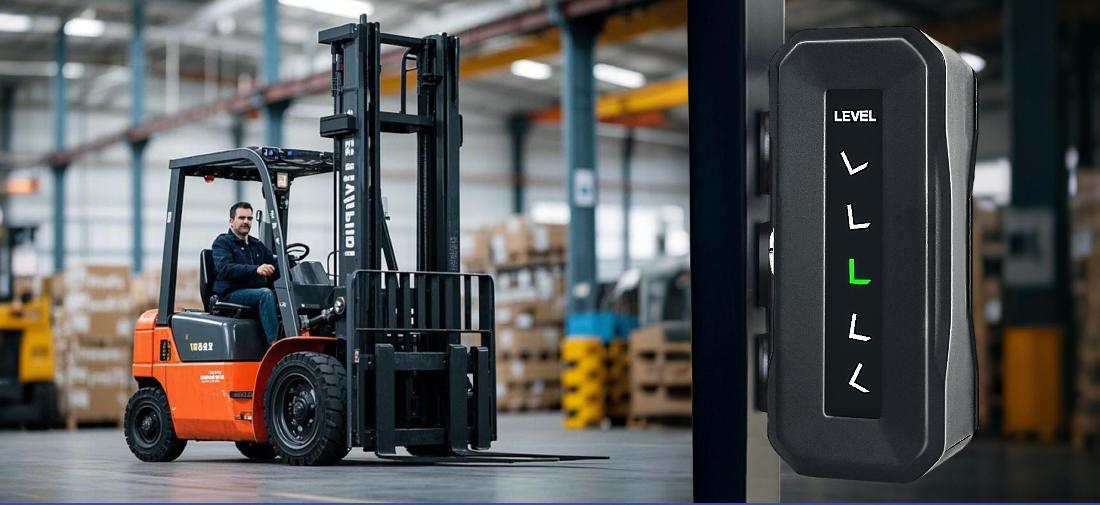
Tip-overs are often caused by mast tilting errors at high elevations. A level indicator gives the operator immediate visual feedback, ensuring the forks are perfectly horizontal before lifting or racking. This reduces product damage and prevents the truck from becoming unstable.
So, what is the most important safety device on a forklift?
It is not just one part. It is a connected system.
The Seatbelt Warning System ensures compliance.
Safety Lights warn pedestrians.
The AI Camera System acts as a second pair of eyes.
Speed Limiters ensure control.
At Toptree Safety, we provide the complete suite of technology required to turn a standard forklift into an intelligent, safe machine. Don't wait for an incident report to identify the gaps in your safety strategy.
Ready to upgrade your fleet?
Contact Toptree Safety today to discuss a custom safety solution for your warehouse.


