English
Views: 0 Author: Site Editor Publish Time: 2026-07-22 Origin: Site
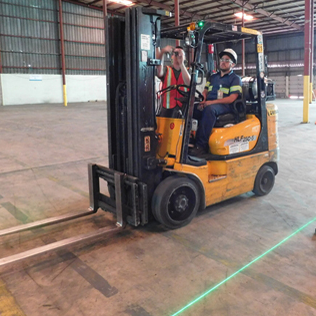
Forklift laser safety lights project a visible line onto the floor beside or around a moving lift truck. The line gives pedestrians an immediate visual reference for the vehicle’s exclusion zone, especially where noise, blind corners, or changing traffic patterns make awareness difficult. The right choice depends on the warning purpose, floor and ambient lighting, mounting geometry, vehicle voltage, and site rules—not color alone.
For most indoor applications, use side-mounted line projectors to define clearance from the truck, set the line far enough away to reflect the truck’s turning and load-handling envelope, and validate visibility from pedestrian eye level under real operating conditions. Treat the projected line as a visual warning layer, not as pedestrian detection, automatic braking, or a physical barrier.
Choose a red line when the site already uses red consistently for danger, stop, or exclusion zones. Choose a green line when it provides stronger contrast against the actual floor and ambient lighting, or when the site’s approved color policy assigns green to a clearly defined route or boundary. In both cases, the meaning must be documented and taught; a color that conflicts with existing signs can create ambiguity.
Select the light only after confirming the required line position, line length and width, visibility, electrical input, mounting space, environmental protection, operating temperature, controls, and applicable laser-safety requirements. A short on-site trial is the most reliable way to verify the choice.
Decision | Red laser line | Green laser line |
|---|---|---|
Typical use | Danger or exclusion boundary | High-contrast pedestrian warning or site-defined boundary |
Main selection reason | Familiar warning meaning in many facilities | Often appears visually bright to the human eye under comparable conditions |
Best fit | Sites with established red-zone rules | Floors or lighting where green gives clearer contrast |
Key caution | Can blend with red floor markings or warm-colored surfaces | Green may imply “safe” if the site has not defined the line correctly |
Required validation | Contrast, viewing angle, line location and worker understanding | Contrast, viewing angle, line location and worker understanding |
A forklift laser safety light is a vehicle-mounted optical projector that forms a narrow, visible line on the floor. As the truck moves, the line moves with it. Pedestrians can use that boundary to judge their proximity to the truck more accurately than they could from an alarm alone.
This technology differs from several products that are often grouped under “forklift safety lights.” A blue or red spot light projects a patch ahead of or behind the vehicle to announce its approach. An LED zone light generally produces a wider, softer boundary. A fixed virtual line laser marks a stationary aisle or walkway. A camera, radar, RFID, ultra-wideband, or LiDAR system detects people or objects and may trigger alerts or vehicle responses. A visible laser line does not perform that detection function.
Side-mounted projectors place a line parallel to the forklift on one or both sides. Their primary purpose is to show pedestrians how close they are to the truck’s body, wheels, load, or turning area. Two projectors—one per side—usually communicate a symmetrical boundary better than a single side light.
Side lines are particularly useful in shared aisles, picking areas, manufacturing cells, and loading zones. However, the projected distance must account for the rear counterweight swing and any load that extends beyond the truck’s normal profile.
A front- or rear-facing line can mark an approach boundary before the truck reaches a pedestrian crossing or work area. This pattern is different from a spot light: a line emphasizes a boundary, while a spot indicates direction and approximate approach.
Avoid positioning a front line where the load or forks frequently block it. A rear line must remain visible during turning and reversing. In many operations, a line works best when combined with an approach spot or audible warning rather than being expected to communicate every direction by itself.
Red is commonly associated with danger or restricted access, making a red line intuitive when the facility already uses that convention. A TOPTREE TPJG01 red laser light is designed to project a thin red line, with a green option also listed, for indoor forklift exclusion-zone applications.
Red is not automatically the most visible color on every floor. Red-painted lanes, rust-colored surfaces, sunlight, and warm industrial lighting can reduce contrast. Test the line on clean and dirty portions of the route before standardizing it.
The human eye is generally more sensitive to green light than red at comparable perceived conditions, which can make a green line appear prominent indoors. The TOPTREE TPJG02 green laser light is intended for a visible floor boundary around moving material-handling equipment.
Color meaning still matters. If green means “safe passage” at your facility, calling the inside of the line a safe zone could be dangerously unclear. Define whether people must stay outside the line, place supporting signs at entry points, and include the rule in induction and refresher training.
TOPTREE’s forklift safety lights category includes line, zone, arrow, and approach-warning formats. Compare technologies by the warning task rather than replacing one with another solely because its output looks brighter.
Correct placement creates a useful floor boundary without exposing people to a direct or reflected beam. Installation should follow the product instructions, the forklift manufacturer’s electrical and structural requirements, and a competent site risk assessment.
Mount the projector high enough to reduce obstruction and tampering, but at an angle that keeps the beam on the floor. Select a rigid location with a clear optical path. The bracket must not interfere with the mast, overhead guard, doors, battery access, operator visibility, or service points.
Set the line outside the truck’s normal profile. The exact offset cannot be universal because forklift width, steering geometry, rear swing, load dimensions, speed, stopping distance, aisle width, and pedestrian behavior vary. Mark the proposed boundary temporarily, drive the truck through straight travel and tight turns, and observe the complete swept path before fixing the angle.
Place a front line where it remains visible with the normal range of loads and fork heights. The line should give pedestrians useful reaction space without appearing so far ahead that it becomes disconnected from the approaching truck. Check it during loaded and unloaded travel and at floor transitions.
Do not use a projected line to define safe clearance from elevated forks or unstable loads. Load handling procedures, exclusion controls, and operator visibility remain essential.
A rear warning line should be visible during reversing and angled so it does not sweep onto walls, people, mirrors, or reflective vehicle surfaces. Test the line through maximum steering angles because the rear counterweight follows a wide arc. A rear approach spot can complement the line when pedestrians need an earlier directional cue.
Keep the projected beam on the floor and below normal eye access.
Use secure hardware suitable for vibration; do not rely on convenient placement alone.
Protect wiring from abrasion, heat, pinch points, chemicals, and moving components.
Confirm the circuit voltage and suitable fuse or protection method.
Check that the light activates under the intended conditions: ignition, travel direction, or another approved control.
Test the line from pedestrian approaches, intersections, doorways, and blind corners.
Repeat the check with typical loads, attachments, floor contamination, and full warehouse lighting.
Record the accepted angle and line offset so maintenance teams can identify movement.
Define what the line is supposed to tell a person: stay outside the truck’s side clearance, expect a reversing vehicle, stop before a crossing, or follow a temporary route. One line should have one consistent meaning. If different departments interpret it differently, the system is not ready for deployment.
Provide the supplier with the proposed mounting height, mounting angle, desired distance from the truck, required visible line length, forklift dimensions, and typical floor distance. A powerful source cannot compensate for unsuitable optics. Ask for a sample or projection drawing when geometry is critical.
Floor color, gloss, texture, dust, oil, water, ambient illumination, sunlight from doors, and the viewer’s position all affect contrast. Test at the brightest time of day and at the least favorable part of the route. Look for specular reflections on polished floors or metal plates and reposition the projector if glare or accessible reflections are possible.
Forklift electrical systems vary across electric, diesel, LPG, and other vehicle types. Confirm nominal and transient voltage conditions, connector preference, current draw, polarity, circuit protection, cable routing, and whether installation could affect the truck warranty. Wide-voltage input simplifies fleet standardization, but it does not replace an electrical check for each model.
Review ingress protection, operating temperature, housing material, vibration resistance, chemical exposure, washdown practice, condensation, freezer transitions, and outdoor use. An IP rating describes specific dust and water tests; it does not by itself prove suitability for every chemical, impact, steam-cleaning, explosive, or corrosive environment.
Request the product’s laser classification, label information, wavelength, output conditions, instructions, and supporting compliance documents. Laser safety depends on accessible exposure, installation, reflections, use, and maintenance—not merely on a marketing description. Have the selected model and installation reviewed under the rules that apply in the destination market and workplace.
Never aim a visible laser at an operator, pedestrian, vehicle mirror, window, or reflective machine surface. Restrict access during adjustment and ensure damaged or misaligned units are taken out of service until corrected.
Choose a housing and bracket that can tolerate normal vibration yet remain easy to inspect. Check cable length, connector access, replacement availability, warranty, and whether the supplier can maintain consistent optical and electrical specifications across repeat orders. A standard mounting record for each truck type reduces accidental variation.
Parameter to specify | Why it matters | Information to send with an RFQ |
|---|---|---|
Warning purpose | Determines pattern and placement | Side exclusion, front approach, rear approach, or another defined task |
Color | Affects contrast and site meaning | Red or green, floor photos, existing color code |
Projection geometry | Determines usable line position | Mounting height, angle, offset, line length and width |
Vehicle details | Prevents fit and electrical errors | Make/model, truck width, power type, system voltage, attachment |
Operating environment | Guides protection requirements | Indoor/outdoor, temperature, washdown, dust, moisture, chemicals |
Lighting and floor | Affects visibility and reflection | Lux range if known, daylight exposure, floor color, texture and gloss |
Controls | Defines when the light operates | Ignition-on, reverse-only, travel interlock, manual switch |
Laser documentation | Supports safe approval | Classification, wavelength, instructions, labels and applicable reports |
Mechanical installation | Affects durability and maintenance | Mounting surface, bracket space, vibration, cable route |
Commercial needs | Supports a complete quotation | Quantity, delivery country, packaging, logo and documentation needs |
Use two side lines when pedestrians and forklifts share an aisle and a clear lateral boundary improves awareness. Add approach warnings at intersections if people cannot see the truck early enough. Where aisle width is insufficient for a meaningful clearance line, redesign traffic flow or separate pedestrians instead of compressing the warning zone until it loses value.
Laser lines provide a location cue that an audible alarm cannot. They should complement—not silence—required alarms. Select the color with the strongest site-tested contrast and repeat the same boundary meaning across the fleet.
Confirm the complete operating-temperature range and performance through warm-to-cold transitions. Inspect for condensation, frost, cable stiffness, and blocked lenses. A product rated for low temperature still needs a mounting and maintenance plan suited to the application.
Daylight can wash out a projected line. Test the product with dock doors open and sunlight at its strongest. If the boundary disappears, use a different optical solution, improve traffic control, or add physical and active warning measures rather than assuming a higher-power light alone will solve the issue.
The first mistake is choosing by color or output figure without a floor trial. The second is copying the same mounting angle across different forklift models. Other recurring problems include placing a line inside the rear-swing envelope, allowing loads to block the beam, using “green” without defining whether it means safe or prohibited, and failing to reinspect brackets after vibration or impact.
Another mistake is treating the light as a collision-avoidance system. A projected line does not know whether a pedestrian has crossed it. If the risk assessment calls for detection, automatic alerts, speed control, interlocks, or barriers, specify those functions separately.
Finally, do not assume that CE, RoHS, an IP rating, or a stated service life answers every local compliance question. Request model-specific documents and have the complete installation assessed for its actual destination and use.
TOPTREE offers two closely related forklift laser line products for indoor visual warning applications:
Model | Color | Published key data | Practical fit |
|---|---|---|---|
TPJG01 | Red | 200 mW, 10–80 V DC, IP67, adjustable bracket, die-cast aluminum housing, CE and RoHS listed, two-year warranty | Fleets seeking a compact side-mounted warning boundary with red-zone meaning |
TPJG02 | Green | 200 mW, 10–80 V DC, IP67, adjustable bracket, die-cast aluminum housing, CE and RoHS listed, two-year warranty | Sites where a green line gives the approved meaning and better tested contrast |
Both models are visual warning devices. Their suitability depends on the mounting geometry, laser documentation, environment, and local approval. Product-page values should be reconfirmed in the quotation and model-specific documentation before purchase.
For a useful recommendation, send TOPTREE photos of the forklift and floor, vehicle voltage, desired mounting position and boundary distance, ambient lighting conditions, temperature range, quantity, destination country, and any logo or packaging requirements. Buyers can also compare the broader range of virtual line laser systems for stationary floor marking, or contact TOPTREE for a model-specific quotation.
No. A laser line is a visual warning boundary. It does not physically stop a pedestrian or vehicle, detect intrusion, or command the forklift to brake. Use physical separation or active protective systems wherever the site risk assessment requires them.
Green often appears visually brighter to the human eye under comparable conditions, but actual visibility depends on wavelength, output, optics, floor color, lighting, distance, angle, dirt, and reflections. Test both options in the intended location rather than selecting by color alone.
There is no universal distance. The boundary should be based on truck width, rear swing, load and attachment envelope, speed, stopping behavior, aisle width, pedestrian route, and site risk assessment. Validate the proposed offset through straight travel and maximum turns.
Outdoor suitability depends on the product rating and environmental exposure, while visibility can drop sharply in direct sunlight. Confirm the model’s intended use and test the projection at the brightest operating time. Do not rely on the line if it cannot remain clearly visible.
Two side projectors are common when a boundary is needed on both sides. Front or rear projectors may be added for specific approach risks. The correct number follows the vehicle’s travel patterns and hazard assessment, not a fixed package count.
Forklift laser safety lights are most effective when they communicate one simple boundary, remain clearly visible in the real workplace, and are positioned from measured vehicle geometry. Choose red or green according to contrast and the facility’s documented color meaning; then verify voltage, mounting, environment, controls, laser documentation, and service needs.
Use the projected line as one layer in a complete pedestrian-safety plan. A site trial, worker feedback, and documented acceptance test will produce a more dependable result than selecting by brightness or color alone.